QUICK ANSWER
Creatine isn't only a muscle supplement. The brain uses the same creatine/phosphocreatine system to regenerate ATP. In a 2024 crossover trial, a single 0.35 g/kg dose of creatine changed brain-energy chemistry measured by MR spectroscopy and improved cognitive performance during about 21 hours of sleep deprivation; a 2026 follow-up at 0.2 g/kg found up to ~12% less decline in some tests. Both used doses far above a standard 5 g serving, and EFSA has not accepted a general creatine-cognition claim.
KEY TAKEAWAYS
- 01Your brain runs the same creatine/phosphocreatine energy system as your muscles.
- 02Kept awake about 21 hours, people given creatine showed changed brain-energy chemistry and better processing speed.
- 03The sleep-deprivation studies used single doses of roughly 16–28 g, far above a 5 g scoop.
- 04At 5 g a day the evidence points to a small effect on cognition, and EFSA has not accepted a general claim.
I went down a research rabbit hole this week, and I want to take you with me.
It started with a question: what's the most interesting thing almost nobody knows about creatine?
The answer turned out to be about your brain.
The setup
You probably associate creatine with one thing: muscle. And that's fair. It's one of the most studied sports supplements in existence.
But here's what almost nobody knows: your brain runs a creatine/phosphocreatine energy system too.
And researchers have now run some genuinely strange experiments to see what happens when they deliberately stress that system.
The experiment
In 2024, a team in Germany recruited 15 healthy young adults for a randomized, double-blind, placebo-controlled crossover experiment.1
Each person served as their own control. On one night they got creatine. On the other, a placebo.
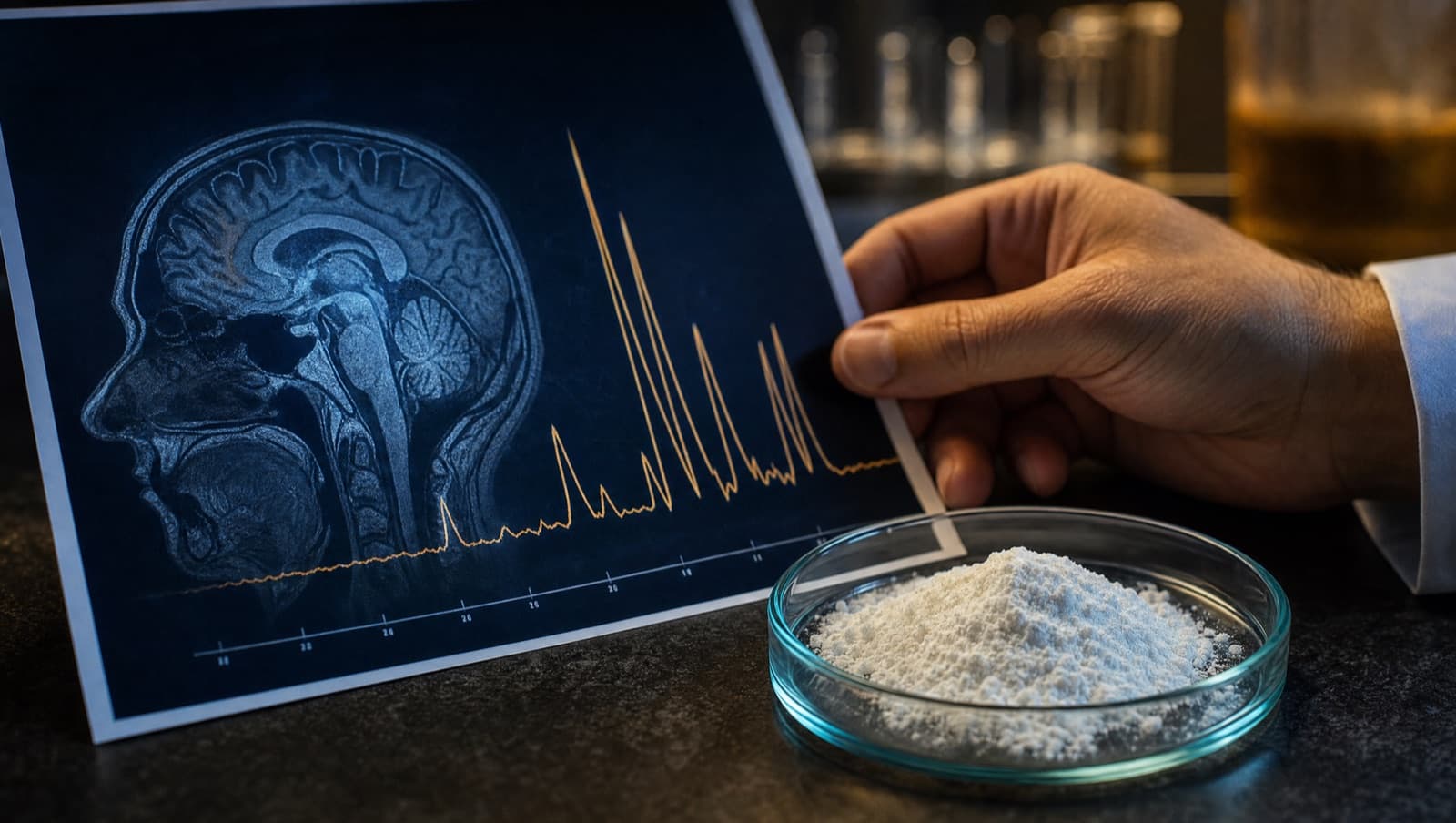
Then the researchers kept them awake for about 21 hours, put them through cognitive tests, and looked inside their brains using magnetic resonance spectroscopy to measure the compounds involved in energy metabolism.
That last part is what makes this study so good. They weren't asking, "Do you feel less tired?" They were watching brain-energy chemistry change while people became sleep-deprived.
The reveal
Creatine changed what happened.
The researchers reported changes in the balance of phosphocreatine to inorganic phosphate, in ATP, and in total brain creatine, and creatine prevented the drop in brain pH that otherwise came with the sleep loss. At the same time, the people on creatine did better on cognitive performance and processing speed as the night wore on.1
In other words: they stressed the brain's energy system, gave it creatine, and saw both metabolic and cognitive differences.
But here's where it gets even better
The dose in that first experiment was enormous: 0.35 grams per kilogram of body weight. For a 175-pound person, that's around 28 grams at once.
So I would absolutely not take this study and say, "One scoop of creatine prevents mental fatigue." It doesn't demonstrate that.
But the researchers found their own result interesting enough to come back and ask: could a lower dose still work?
That study was published in 2026. Twenty-nine healthy adults, the same crossover design, the same 21 hours without sleep. This time the dose was 0.2 g/kg, around 16 grams for a 175-pound person.2
And again, creatine appeared to reduce some of the cognitive deterioration from sleep deprivation, with improvements of up to roughly 12% in some measures: logical and numerical tasks, language-related processing speed, and the Psychomotor Vigilance Test. The effect was smaller than at the higher dose, and women benefited more than men on several tasks.2
Not every individual comparison held up after correcting for multiple statistical tests. So this is intriguing emerging evidence, not established fact.
The biology
Here's the deeper point: creatine isn't fundamentally a "muscle-building molecule."
Its fundamental job is closer to being an energy buffer.
Cells spend ATP to do work. ATP becomes ADP. The phosphocreatine system can rapidly donate a phosphate group to regenerate ATP. Muscle depends heavily on that during explosive activity.
But neurons need ATP too.
So the real creatine story is this: muscles and brains both face moments when energy demand temporarily outpaces the rate at which ATP can otherwise be regenerated.
That turns creatine from a bodybuilding ingredient into a much broader story about cellular energy, which is the lens I keep coming back to for almost everything in health.
The honest part
I want to be straight with you, because this is where most supplement content goes off the rails.
Back in 2003, researchers gave 45 young vegetarians 5 grams of creatine a day for six weeks, and their working memory and reasoning scores improved.3 But when a much larger preregistered trial tested the same 5 g a day in 123 people twenty years later, the evidence supported only a small benefit.4
A 2024 meta-analysis of 16 trials and 492 people found significant effects on memory, attention time, and processing-speed time, but not on overall cognition or executive function, and it rated the certainty of most of that evidence as low.5 And in late 2024 the European Food Safety Authority reviewed creatine and cognitive function and concluded that a cause-and-effect relationship has not been established.6
So I'm not telling you creatine makes you smarter. That would be a lie.
What I am telling you is that the most interesting signal shows up in stressed brains, like sleep-deprived ones. And that's a genuinely fascinating place to look.
What I think people get wrong
We file creatine under "gym supplements." But it's part of the energy-buffering system used by cells throughout your body, including your brain.
That's a much more interesting way to think about it.
The connection
We use creatine in Monthlees Creatine Monohydrate: 5 grams per scoop, the standard daily amount used throughout the research, including the 2003 and 2023 cognition trials above. ATP+ pairs the same 5 grams with sodium, potassium, and magnesium.
But I'm not going to pretend either product was the thing tested in the sleep-deprivation studies. It wasn't. Those used much larger single doses.
The takeaway
Next time someone tells you creatine is just for muscle, you'll know the fuller story: your brain runs the same energy system. And when researchers deliberately stressed it with a night without sleep, creatine changed what happened, both in the chemistry and in the performance.
That's the kind of thing I can't stop thinking about.
REFERENCES
- Gordji-Nejad A, Matusch A, Kleedörfer S, Jayeshkumar Patel H, Drzezga A, Elmenhorst D, Binkofski F, Bauer A. Single dose creatine improves cognitive performance and induces changes in cerebral high energy phosphates during sleep deprivation. Scientific Reports 14:4937; 2024. doi:10.1038/s41598-024-54249-9 · PMID 38418482
- Gordji-Nejad A, Matusch A, Hengstler L, Beer S, Kroll T, Klein S, Elmenhorst D, Bauer A, Drzezga A. Single-Dose Creatine Reduces Sleep Deprivation-Induced Deterioration in Cognitive Performance. Nutrients 18(8):1192; 2026. doi:10.3390/nu18081192 · PMID 42075005
- Rae C, Digney AL, McEwan SR, Bates TC. Oral creatine monohydrate supplementation improves brain performance: a double-blind, placebo-controlled, cross-over trial. Proceedings of the Royal Society B 270(1529):2147–50; 2003. doi:10.1098/rspb.2003.2492 · PMID 14561278
- Sandkühler JF, Kersting X, Faust A, Königs EK, Altman G, Ettinger U, Lux S, Philipsen A, Müller H, Brauner J. The effects of creatine supplementation on cognitive performance — a randomised controlled study. BMC Medicine 21:440; 2023. doi:10.1186/s12916-023-03146-5 · PMID 37968687
- Xu C, Bi S, Zhang W, Luo L. The effects of creatine supplementation on cognitive function in adults: a systematic review and meta-analysis. Frontiers in Nutrition 11:1424972; 2024. doi:10.3389/fnut.2024.1424972 · PMID 39070254
- EFSA Panel on Nutrition, Novel Foods and Food Allergens (NDA). Creatine and improvement in cognitive function: evaluation of a health claim pursuant to Article 13(5) of Regulation (EC) No 1924/2006. EFSA Journal; 2024. doi:10.2903/j.efsa.2024.9100
This article is for education and is not medical advice. Talk to your clinician before changing supplements or medication. Report a correction
Disclosure: Monthlees is a company founded by Christopher Walker.